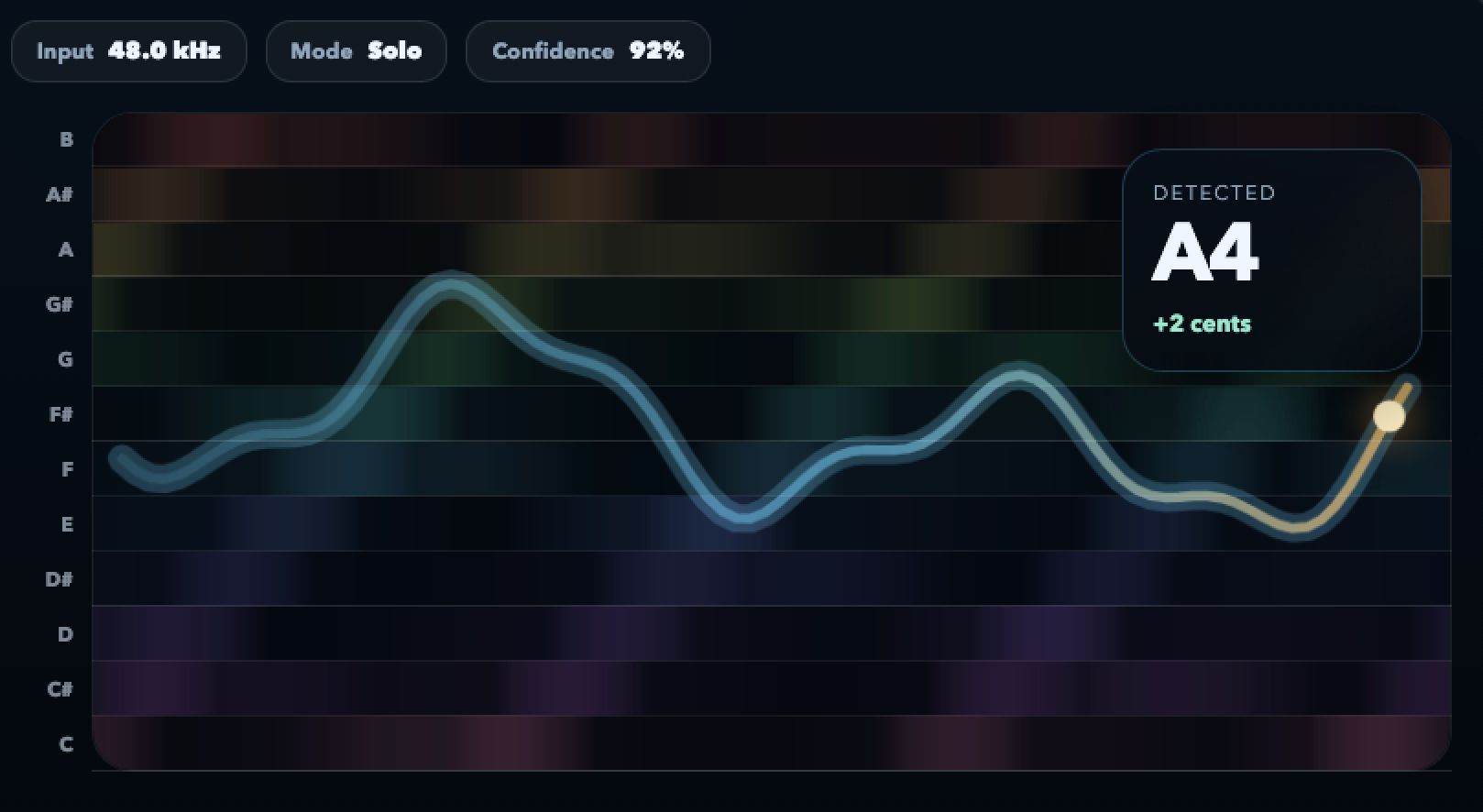
Around 30 Hz the fundamental is weaker than the harmonics. Fiume is tuned to catch it anyway.
Online bass tuner
A bass tuner that actually locks on the low B
4, 5 and 6-string electric, plus upright. Standard EADG, BEAD, Drop D and extended ranges — all in the browser, with a pitch engine designed to catch low fundamentals instead of chasing harmonics.
Free. No account. Direct input or mic, both work.
Standard EADG, BEADG, BEADGC — pick yours and get to work.
DI through an interface, mic on the amp, mic on the bridge — all three work.
Pitch detection runs in your browser. No signup, no audio leaving your device.
Tunings
Bass tunings covered in one tuner
Most bassists end up needing at least three tunings across a career. Fiume keeps them one click apart.
Standard & flat variants
EADG, Eb standard, D standard and C# standard — useful for rock, modern metal and a lot of session work.
BEAD & drop tunings
BEAD (down a fourth) and Drop D (DADG) add lower register without a 5-string. Drop C and Drop B are covered for heavier music.
5 and 6-string extensions
Add a low B (BEADG) or both low B and high C (BEADGC) for extended-range parts. All targets are preset.
Bassists who use it
Situations Fiume’s bass tuner handles well
The common reasons a bass player opens a tuner — covered without needing a separate app for each.
-
Home practice Open a tab, plug into the interface, tune in ten seconds. Done.
-
Studio tracking Verify tuning between takes with cents-level precision — the contour catches slow drift the needle misses.
-
5 and 6-string players Low B, low F# and high C are all presets. No fighting the tuner to accept notes below standard range.
-
Metal and down-tuned rock Drop D, Drop C, Drop B and BEAD are one click away. Good for rehearsals where the guitarist changes tuning mid-session.
-
Upright & jazz Clip a small mic near the bridge and tune quietly backstage without reaching for a pickup.
-
Students & lessons Share one link with a teacher or student so tuning is never the reason the lesson started late.
How to tune
Tuning a bass in three steps
Slow strokes, clean signal, one pass back. Works for 4, 5 and 6-string the same way.
-
1
Pick the preset
Choose EADG standard, BEAD, Drop D or your 5/6-string configuration. Fiume loads the right target pitches.
-
2
Play each string cleanly
Use a medium plectrum or fingerstyle stroke. Mute unused strings so the tuner is not reading a neighbour.
-
3
Re-check the low string
Neck tension shifts while you tune. One sweep back catches the low string drifting after you tuned the others.
FAQ
Bass tuner questions, answered
Why does my low B flicker between B and B#?
The fundamental at 30 Hz is quiet, and harmonics can fight for dominance. Pick over the neck pickup with less treble to stabilise the reading.
Can I use my amp’s DI out?
Yes. A DI out into an audio interface gives the cleanest possible signal — almost always better than miking the cabinet.
Does it work while I am recording?
Yes. The tuner uses the same mic input, so you can leave it open in another tab and glance at it between takes.
What about fretless bass?
Same tuner, same routine. Fretless open strings tune exactly like fretted, and the contour is especially useful for intonation checks in upper positions.
Can I use a phone for bass?
Yes. A phone mic handles a bass amp in the same room easily. For direct input, a phone-compatible interface works too.
Does it replace a pedal tuner on stage?
On stage, a pedal tuner is still better because it mutes the signal. At home, in the studio and in rehearsal rooms, a browser tuner is usually faster.
Tune your bass in the browser, low B included
Plug in, pick your tuning, play. Fiume handles the low end so you do not have to troubleshoot a tuner.
Open bass tunerFree, private, no account needed.