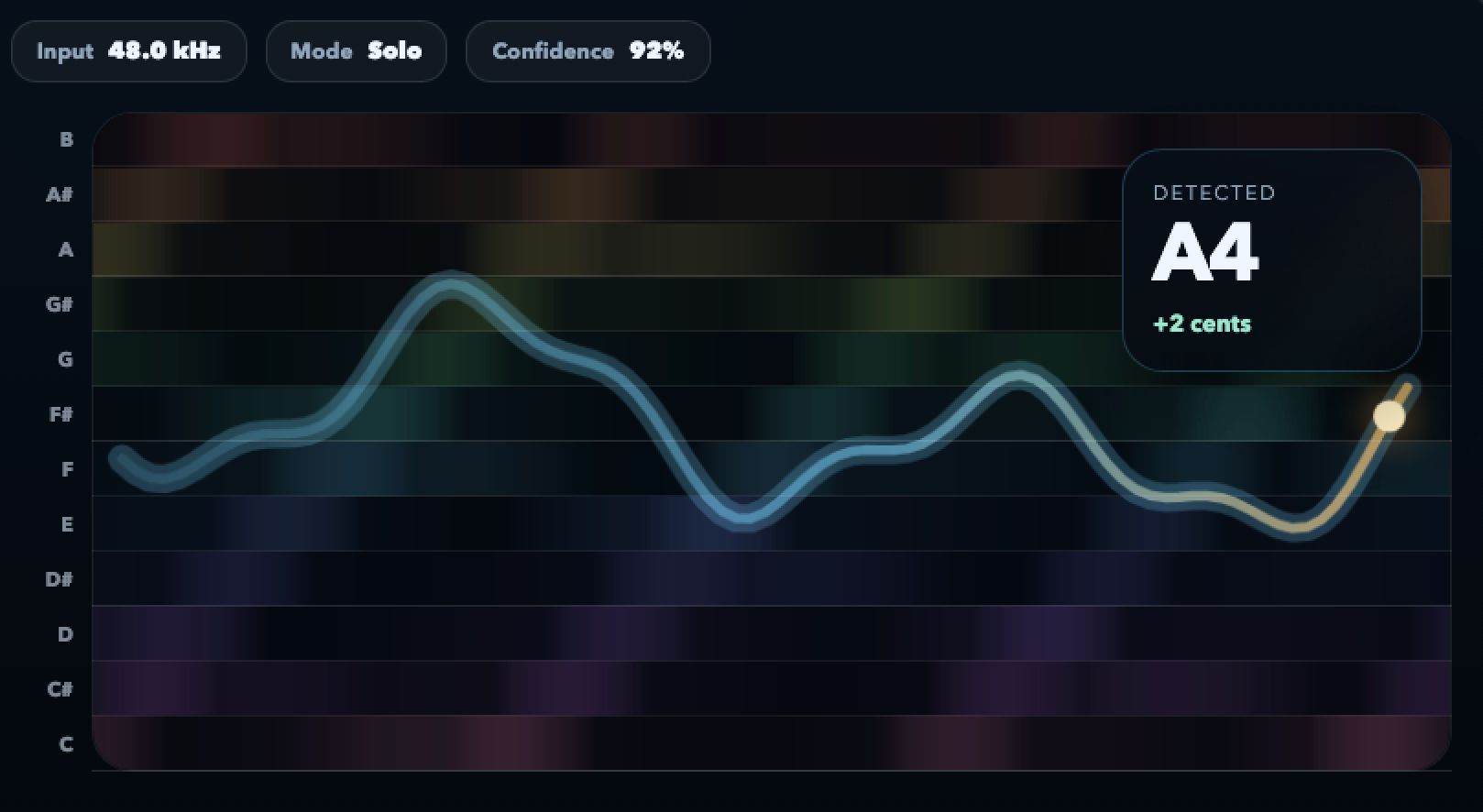
Pluck any string and the tuner jumps to it — no manual string-picker, no guessing.
Online ukulele tuner
One ukulele tuner for every size and every tuning
Soprano, concert, tenor — GCEA, high-G or low-G — and baritone in DGBE. Fiume handles them all in the browser, with cents-level accuracy on four nylon or fluorocarbon strings.
Free. No account. Works on phone, tablet or laptop.
Soprano, concert, tenor and baritone — each with its correct preset ready to go.
The G string lives in two places at once. Fiume recognises whichever one you installed.
Phone, tablet, laptop — no install, no sign-up, audio stays in your browser.
Tunings
The ukulele tunings Fiume supports out of the box
If you have played a ukulele, you have probably used more than one of these. Fiume switches between them in a single click.
GCEA (re-entrant high-G)
The standard soprano, concert and tenor tuning. The high-G on top is what gives the ukulele its classic jangly sound.
GCEA with low-G
Replace the re-entrant G with a low G for fingerstyle, jazz and solo arrangements that need a lower bass note.
DGBE baritone & D tuning
Baritone ukuleles use DGBE (like the bottom four strings of a guitar). Old songbooks also use D tuning (ADF#B) — both covered.
Ukulele players who use it
Who Fiume’s ukulele tuner is for
Beginner first-day ukulele or tenor with a pickup — the tuner behaves the same either way.
-
First-week beginners Tune your first ukulele without needing to know what GCEA means. The preset does it for you.
-
Strummers and songwriters Check tuning fast between songs at home without breaking out of the creative flow.
-
Fingerstyle players Switch to low-G for more melodic range and hold accurate tuning while new strings stretch in.
-
Baritone players DGBE tuning ready in one click — no more trying to pretend a soprano tuner works well enough.
-
Classroom and group lessons One shared link, twenty students, all in tune before the lesson actually starts.
-
Hawaiian & slack-key Traditional tunings are supported too, so you are not forced back into standard GCEA every time.
How to tune
Tuning a ukulele in three steps
Ukuleles move quickly at first because the strings are soft. Plan on a second pass right after the first — it is normal and not a problem with your instrument.
-
1
Pick your preset
Choose GCEA (high-G or low-G) or DGBE baritone. Fiume loads the correct target pitches for each string.
-
2
Pluck each string
Go string by string, turning the tuning peg until each reading centers. A smooth pluck with no muting gives the cleanest reading.
-
3
Repeat once more
Ukulele strings settle for several days. A second pass immediately after the first keeps all four strings in tune with each other.
FAQ
Ukulele tuner questions, answered
Why does my new ukulele go flat so fast?
Nylon and fluorocarbon strings stretch for a few days. This is normal. Retune frequently at first; after two or three sessions they hold pitch well.
Should I tune G, C, E, A or some other order?
Either direction works. Many players go C first (the deepest note of the chord), then G, then E, then A, finishing with a chord strum to confirm the set.
Can I use this on a banjolele or cavaquinho?
Yes for banjolele (same GCEA tuning). Cavaquinhos can vary; Fiume reads the actual pitch, so any target tuning you know the notes for will work.
Does it need internet to work?
The first load does. After that, the tuner keeps working in the tab even if your connection drops.
Is it really as accurate as a clip-on?
For home practice and teaching, yes. A clip-on is still more reliable in very noisy environments like a crowded beach or a busking spot.
Is it safe for kids’ devices?
Yes. No account, no login, no audio upload. The page only uses the microphone while the tab is open.
Tune your ukulele in under a minute
Pick your preset, pluck each string, play a chord. That’s the whole routine.
Open ukulele tunerFree, private, no account needed.