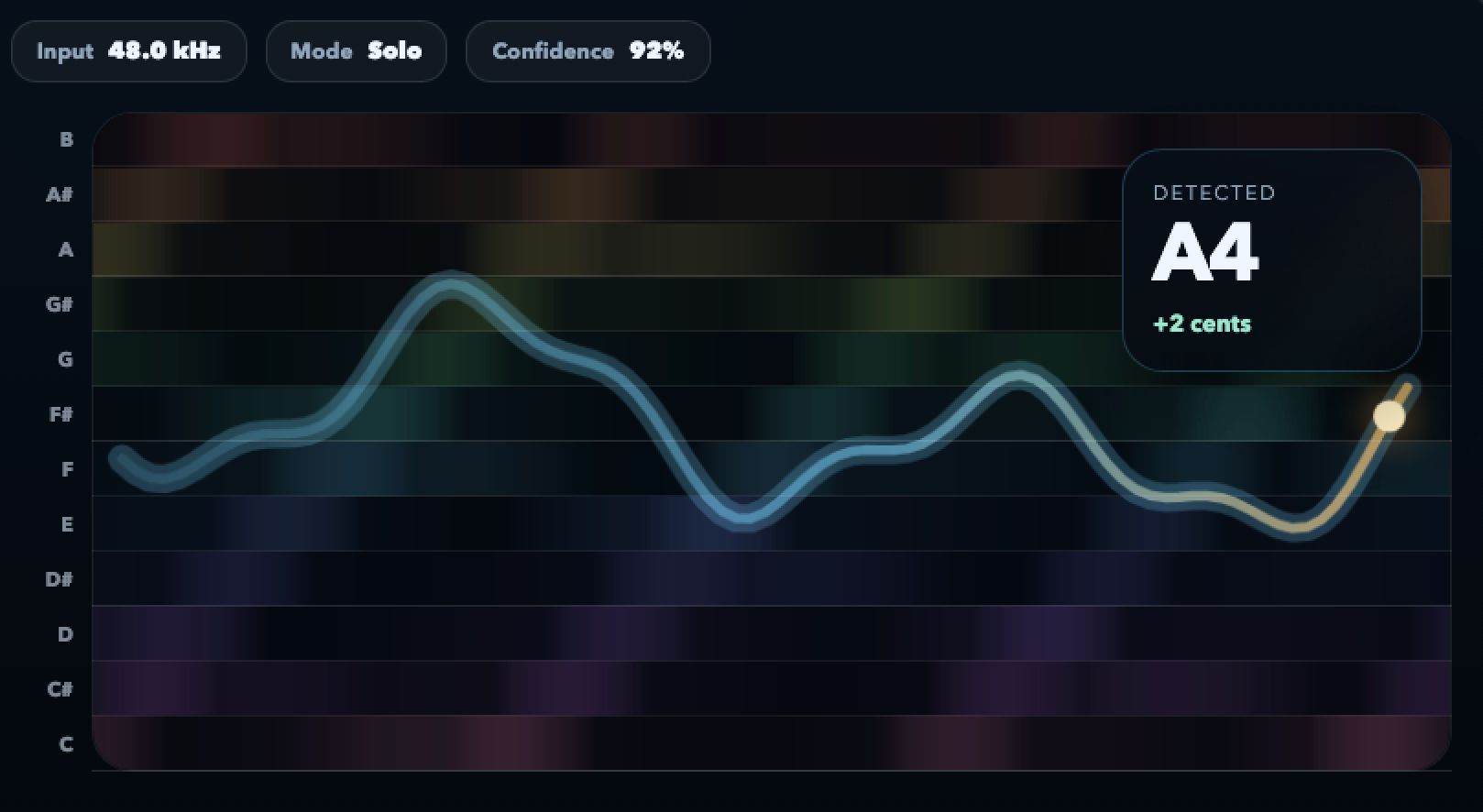
Bow any string; the tuner jumps to it. No need to tell it which you are tuning.
Online violin tuner
A violin tuner that takes fifths seriously
G3, D4, A4, E5 — tuned to A=440 or A=442 with cents-level precision, and a live contour that shows whether your double-stop fifths actually lock. Runs in the browser, no install.
Free. No account. Audio stays in your browser.
Switch reference pitch to match your section. Baroque (A=415) is also supported for period work.
See the contour of a held bow stroke — not just a needle flick. Drift becomes obvious.
No account, no upload. Audio is processed on-device, the way your violin teacher would prefer.
The fifths problem
Why tuning in fifths is the part that matters
A violin can have every open string “on pitch” and still not be in tune, because the relationships between the strings are what the ear judges. Fiume was built to help with that.
Tune A first
Start with A4 against the reference. Everything else is built off this one note, so a sloppy A means sloppy fifths everywhere else.
Check the fifths as pairs
Bow A–D, then D–G, then A–E as double-stops. The contour should hold steady — if it wobbles, the fifth is not quite true.
Small moves with the fine tuners
Big adjustments belong at the pegs. Once you are close, the fine tuners let you fix the last two or three cents without overshooting.
Players who use it
Situations Fiume’s violin tuner was built for
From weekly lessons to orchestral pit work, the same tuner covers the common use cases without asking you to install anything.
-
Students and early learners Get in tune before the lesson so you and your teacher spend time on playing, not on pegs.
-
Orchestra rehearsal Check your strings before the section tunes together. Flip to A=442 when your group uses a higher pitch standard.
-
Chamber music Compare your A to the other strings in the quartet. Shared reference, same tab, no extra hardware.
-
Fiddle and folk Works for cross-tunings like A D A E. Any open pitch is detected; you are not locked to standard only.
-
Baroque and historical Switch to A=415 for period instruments without hunting for a specialised tuner.
-
Teachers and studios Share one link; every student opens the same tuner on any device and is ready when the lesson begins.
How to tune
Three passes to a clean set of fifths
The classical routine — A first, outward, then back. Fiume just makes each pass more obvious.
-
1
Set A against the reference
Bow A4 with a medium-weight stroke. Nudge with the fine tuner until the contour sits centered for a full second.
-
2
Work outward: D, G, then E
Move in fifths from the A. Check each new string as a single note first, then as a double-stop with its neighbour.
-
3
Sweep back and commit
Return to A. Neck tension shifts as you tune, so a final pass catches strings that drifted while you adjusted the others.
FAQ
Violin tuner questions, answered
Do I need an electronic tuner on a clip?
Not for practice or studio work. A browser tuner is more informative because it shows how the note behaved, not just a final snapshot.
What if my open string reads a minor third off?
The tuner is reading whatever the string is producing. Turn the peg until the reading lands on the expected letter name, then use the fine tuner from there.
Can I use it with a shoulder rest and mic clip?
Yes — a small clip-on or lavaliere microphone close to the bridge gives a very clean signal and reduces room noise.
Does it listen while I practice scales?
Yes. Leave the tab open and Fiume continues to track pitch, so you can use the same page for tuning and for intonation drills.
Does A=442 affect all four strings?
Yes. The whole set shifts together. G, D, A and E are all recalculated from the new reference, so the fifths still line up correctly.
Is audio sent to a server?
No. Pitch detection runs entirely in your browser tab. Nothing you play gets uploaded or stored anywhere.
Tune your violin, in fifths, in the browser
Open the tuner, set your A, and walk the strings outward. Fiume does the judging in between.
Open violin tunerFree, private, no account needed.